
Inheriting 400 Metal Lockers: A Vendor-to-Vendor Migration in Malta
A 1,000-employee office in Malta already had a smart-locker installation from another vendor. The hardware was fine; the software was not. Here is how we retrofitted 400 metal lockers — physically — onto the MyLock stack without ripping them out.
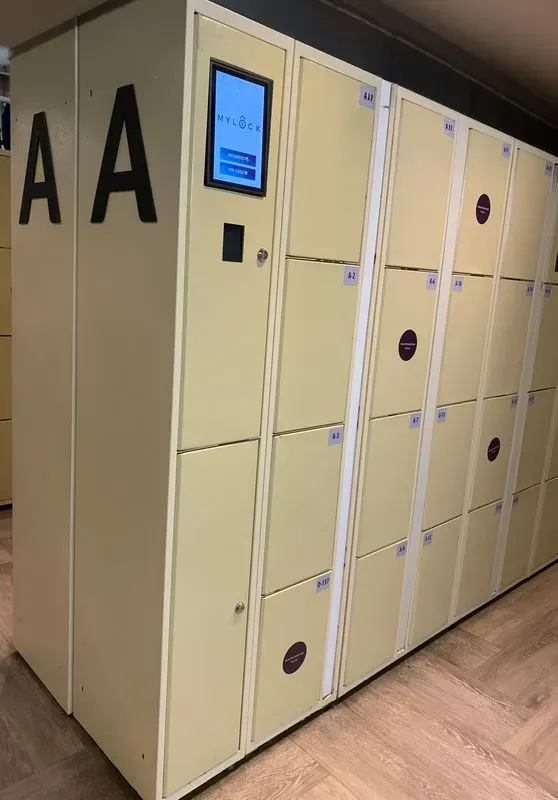
Most of our case studies start the same way: a client decides to install smart lockers, picks us, we deliver the rollout. The project we ran in Malta last year started differently — the client already had smart lockers, from a different vendor, and they wanted the locker boxes to stay exactly where they were.
This is the project we get asked about most when prospects realise we are willing to do it. Inheriting somebody else's hardware is genuinely uncommon in our industry; the default is rip-and-replace. Here is what the alternative actually looks like in practice.
The site: 1,000 employees, 400+ existing metal lockers
The client operates a large office in Malta with more than a thousand employees across multiple departments. The locker rooms had been built out a few years earlier with metal lockers manufactured in Eastern Europe — solid, well-built hardware, the kind of professionally welded steel that will outlast the building. The doors, the hinges, the latch mechanisms, the structural frame — all of it was fine.
The smart-locker electronics on top of that hardware — the original vendor's control units, software, and management portal — were the problem. The client could not get the operational visibility they needed: no live status, no usable metrics, no flexible rules. The system worked, but it was opaque. After a year of running it, they had decided the platform was not going to grow with them.
The natural conclusion would have been to tear out the metal lockers and start over. They asked us first if we had another option.
The site visit, before any commitment
We do not quote vendor-migration projects without seeing the site. Too many things can go wrong: the existing lock mechanisms can be too proprietary to interface with, the door cavities can be too tight to fit new electronics, the wiring runs can be unreachable without major demolition. Any of these can turn a "swap the brains" project into a full rebuild — at which point the economics shift back toward rip-and-replace.
A team from MyLock flew to Malta for a multi-day on-site assessment. We measured door cavities, opened sample units, traced the existing wiring, examined the lock mechanisms, and modelled what a clean integration would look like. We also took the client through the trade-offs: which physical modifications would be needed, what cosmetic impact would be visible afterward, and what they would lose vs. gain compared with a full rebuild.
The site was a good candidate. The existing locks were standard-enough to be driven by our electronics with a custom connector board. The door cavities had enough internal depth to mount our reader hardware. The wiring runs were accessible. We committed to the project.
The hardware we brought
A migration project at this scale needs more than a software change. We shipped a working kit of the MyLock stack to Malta:
- New touchscreen terminals to replace the existing control units, one per locker room
- QR scanners for the touchscreen interfaces
- PCs and embedded controllers for the new control logic
- Dedicated connector electronics — custom interface boards designed to drive the existing metal-locker locks from our system without modifying the lock mechanisms themselves
- All the cabling, mounts, and power distribution to wire it together
This is not off-the-shelf for a migration. Each connector board was specified during the site visit and built to match the existing lock specification we had measured. By the time the install team arrived in Malta, every piece had a known place to go.
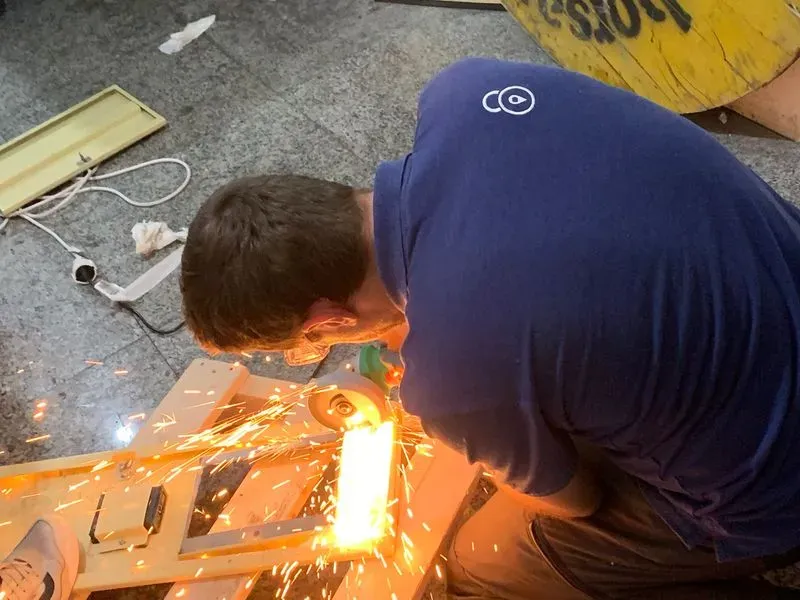
We also shipped a serious tool kit: angle grinders, metal-cutting saws, drills with metal bits, mounting hardware. Retrofitting electronics into hardened steel is genuinely a metalwork job, and a sizable portion of the on-site time was physical fabrication.
The on-site work
The migration ran in phased sections across the two locker rooms, similar to the staged approach we used on the Malta expansion case — staff kept access to unmigrated rows while we worked on the active section. Per row, the workflow was roughly:
- Decommission the existing electronics and disconnect them from the locks. The original vendor's hardware was removed cleanly — no destruction, just unmount.
- Cut and drill the necessary mounting points for our reader, controller, and connector board. This is where the metal-cutting tools earned their travel cost; precision cuts in 2 mm steel that need to look professional when finished.
- Install our electronics. Wire each lock to our connector board. Test the open-close cycle on the new system.
- Bring the row online in MyLock Cloud, validate end-to-end with a test PIN, and hand the row back to operations.
In total, more than 400 lockers were migrated across the project. The physical install was heavier than a greenfield phenolic install — drilling and cutting steel is slower than mounting electronics into pre-prepared phenolic panels — but the resulting fleet behaves like any other MyLock Cloud installation we run.
What the client got after migration
The hardware looks essentially the same as it did before. The change is in what is now visible:
Live status, every door. The admin team can see which lockers are occupied, which are free, which have expired, which need cleaning, in real time. They could not see any of this on the previous platform.
Filtered historical logs. Access events are queryable by user, by locker, by time window. The previous platform exported audit data in a flat format that the operations team had effectively stopped using because it was too painful to work with.
Configurable rules. Expiration windows, cleaning windows, conditional access — all editable in the portal, just like we describe in the Bucharest case study. Behaviour changes do not require vendor support tickets.
API integration. The client's HR system is now wired into the locker lifecycle. The previous platform did not expose a usable API; integration had been on the roadmap for over a year. We got it live in the first months after migration.
The client's operations lead has told us they should have asked us about migration earlier — they had been resigned to ripping out the lockers and starting over until they realised the inheritance option existed.
When vendor migration makes sense
Three conditions tend to make a migration project the right call rather than a rebuild:
- The physical hardware (doors, frames, locks) is in good condition and has years of useful life left. Replacing structurally sound steel furniture because the electronics are bad is genuinely wasteful — both economically and environmentally.
- The existing lock mechanisms can be driven by interface electronics without invasive modification. Most professional smart-locker locks meet this bar; some niche or proprietary mechanisms do not. The site visit is where this gets confirmed.
- The client values not interrupting service. A staged migration keeps the locker rooms operational throughout. A full rebuild typically involves multiple days of partial or total downtime.
If you are operating a smart-locker fleet that you are unhappy with, and the boxes themselves are fine, the option of swapping vendors without swapping hardware is worth a conversation. Get in touch and we will scope a site visit.
A note for context: Malta was not our first vendor-migration project. A year earlier we had run a similar retrofit in Kaunas, Lithuania, on lock hardware that was a generation older — that one is written up here if you want the comparison.