
Two Doors Per Column: A Custom-Fit 350-Locker Design in Sofia
A 350-locker office deployment in Sofia, Bulgaria, where the unusual two-per-column layout with built-in coat hangers came from looking hard at how staff actually used their lockers. Built with Inbeca phenolic, rated for 4,000 daily openings.
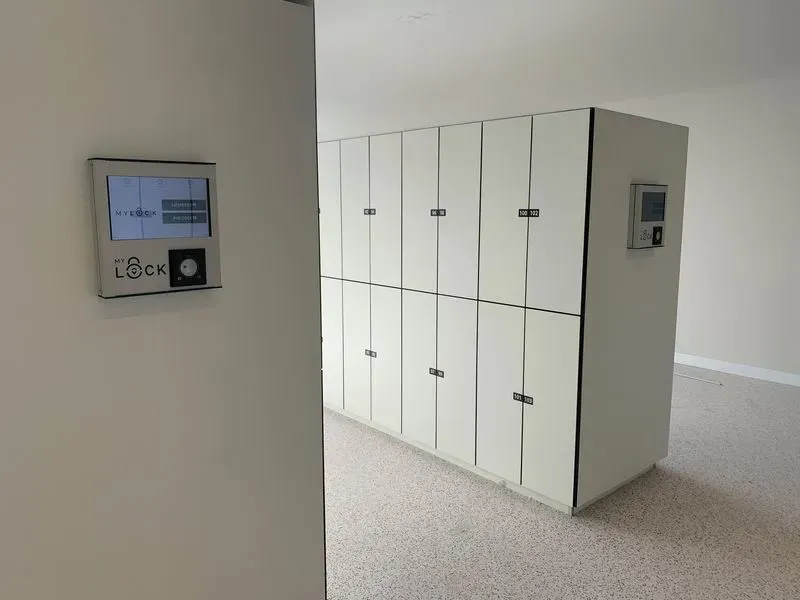
A locker is a box that opens. There is not much to design — until you watch someone use one.
The 350-locker installation we delivered in Sofia early last year started, like most of our office deployments, with a standard column layout: four to six lockers stacked vertically, each sized for a small bag and personal items. That was the spec we showed the client in the first proposal.
It was wrong, and they told us why.
The brief: staff who walk to work in winter
The client's office is in the heart of Sofia. A large share of their staff commute on foot — meaning, in winter, a heavy coat and a scarf. Throughout the day many of them also keep a change of clothes for the gym they go to after work. The standard small-bag locker we had drawn up could fit either the coat or the bag — not both, and not comfortably.
The fix was not a bigger locker per person. It was a different column shape.
Two large doors per column, with built-in hangers
Working with our manufacturing partner Inbeca, we redesigned the column to hold two larger doors instead of four small ones. Each locker is roughly twice the volume of our standard office unit, with internal dimensions that comfortably fit a winter coat on a hanger plus a backpack underneath. We added a horizontal hanger rail at the top of every locker, integrated into the phenolic frame.
That is the entire design change. It sounds trivial. It changed the usage pattern more than anything else in the build.
The same column footprint now serves the same number of staff — coat hung properly, bag in the bottom, no folding, no compression damage to clothing. Before this change, the operator told us, staff were stuffing coats around bags and complaining about wrinkled jackets. After, no one mentioned coats again. Lockers had become invisible the way good infrastructure should be.
The material story
The doors are compact phenolic resin, 13 mm thick, with a micro-perforated back panel for ventilation — Inbeca's standard high-traffic spec. We picked white phenolic with a modern two-sided finish that fits the client's contemporary office aesthetic, the kind of design that disappears into the building rather than calling attention to itself.
The mechanical rating matters here. With 350 lockers, two daily uses per locker (morning drop-off, evening pickup) plus periodic interim access, the site moves through roughly 1,000–1,500 openings on a normal day, peaking above 4,000 during occasional staff events. Inbeca's phenolic and our electronic locks are rated comfortably above that — the install has run cleanly for a year now without any door or hinge failures.
Four ways to open a door
Different members of staff prefer different things. We gave them all four:
- PIN code — the default, fastest to use, easiest to recover.
- QR code — generated in the user's onboarding email; useful for staff who like keeping locker access on their phone.
- RFID card — wired into the same card the client already uses for building access. Tap once, locker opens. No second credential to manage.
- Fingerprint — opt-in, captured at first use. Lives on-device in the secure element.
Crucially, every locker accepts every method. There is no "fingerprint row" and "PIN row." A user can switch between methods month to month with no admin action.
This is one of the differences between MyLock Cloud and lower-cost locker software: the authentication options are not features you buy à la carte. They are part of the platform.
The "what if the network is down" question
Every smart-locker proposal has the same trust hurdle, especially in office environments where IT teams are sceptical of internet-dependent infrastructure: what happens if the system goes offline?
Two answers in Sofia:
Battery backup, 3 hours. Each control unit has a UPS that keeps it running through a 3-hour outage. Authentication continues, lockers open and close normally. In our experience this covers more than 99% of real-world power events on a commercial site.
Manual emergency mechanism on every door. Even in a scenario where the electronics are out completely, the building security team has a physical override that opens any locker. The mechanism is keyed and tracked — it leaves an auditable trail — but it ensures no employee belongings are ever inaccessible because of a power or network failure.
Operationally, the manual override has been used roughly twice since install, both for forgotten items after employees travelled. That is exactly the failure mode it is meant for.
What the deployment taught us
The 350-locker number in Sofia is unremarkable. We have done bigger deployments. What made this one matter to us internally was the reminder that the locker-room design has to come from the locker-room use.
Defaulting to "more, smaller lockers" because that is the textbook office layout would have led to a year of low-grade staff complaints about wrinkled coats. Asking the client what their staff actually carry to work, on what days, and matching the box to the load, was the design work. The manufacturing and the software were straightforward by comparison.
If you are scoping a deployment in an office where the usage pattern is non-standard — coats, sports gear, parcels, shift uniforms — that is the conversation worth having early. Get in touch and we will work through it with you.